Wasp (Polistes spp.), Yellow Jacket (Vespula spp.) & Hornet Control in Southern Indiana
Greener Pest Management provides targeted control for paper wasps (Polistes spp.), yellow jackets (Vespula spp.), bald-faced hornets (Dolichovespula maculata), and European hornets (Vespa crabro) throughout Southern Indiana. We identify the insect, locate the nest or activity zone, and recommend treatment only when it is actually warranted. Whether the nest is under an eave, underground, inside a wall void, or hanging from a tree, our goal is straightforward: solve the problem with the right treatment, in the right place, for the right reason.
Wasp, Yellow Jacket & Hornet Control in Southern Indiana
Stinging insects can go from a minor nuisance to a serious problem quickly when a nest is built near a doorway, deck, play area, landscaping, or another part of the property people use every day. Greener Pest Management provides professional stinging-insect identification and control throughout Southern Indiana, including Washington County, Jackson County, Scott County, Lawrence County, Harrison County, Clark County, and Orange County.
We commonly respond to problems involving paper wasps (Polistes spp.), yellow jackets (Vespula spp.), bald-faced hornets (Dolichovespula maculata), and European hornets (Vespa crabro). We also receive plenty of calls about large ground-nesting insects such as cicada killers (Sphecius speciosus) and solitary mining bees (Andrenidae) that often look intimidating but usually do not warrant pesticide treatment.
Identification matters. We are not interested in showing up and spraying something simply because it flies and has a stinger. We identify what you are dealing with, determine whether it is actually creating a pest or safety issue, and choose a response that fits the situation.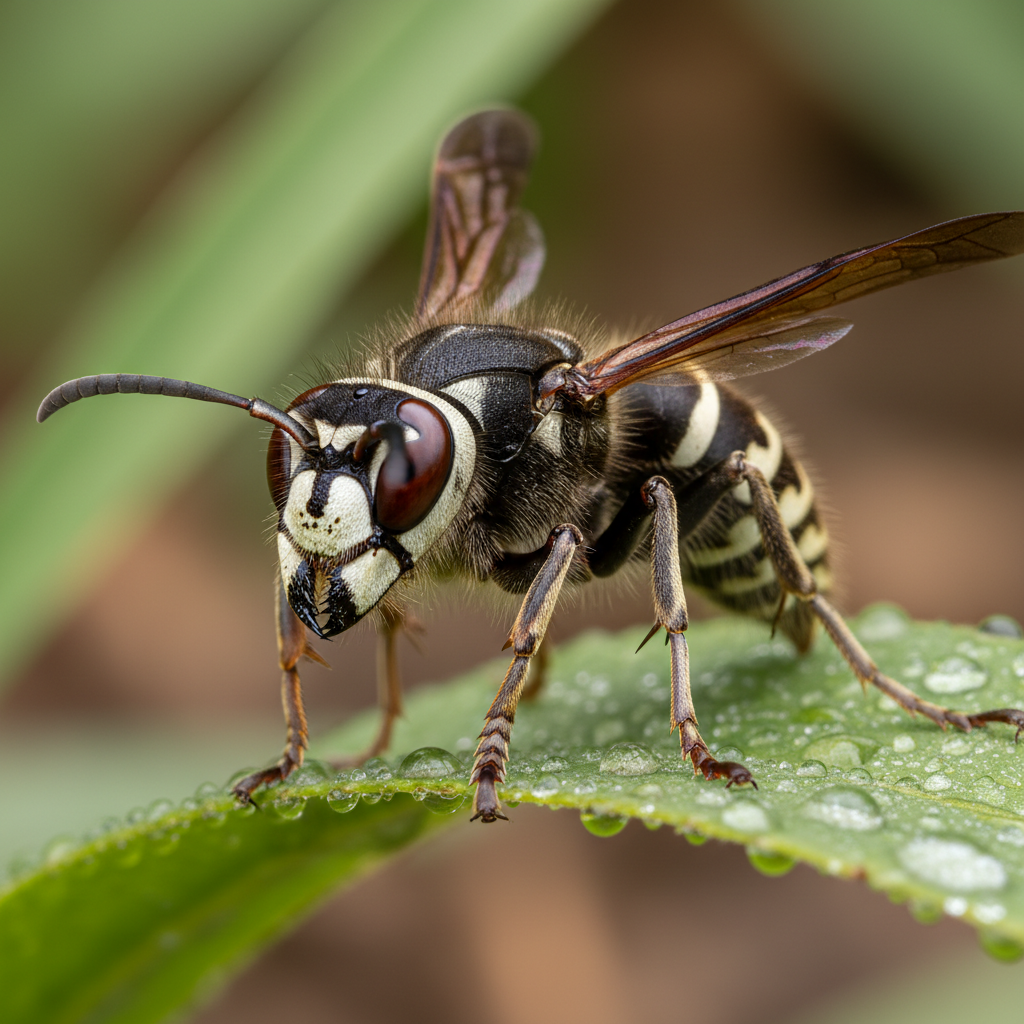
Why Professional Stinging-Insect Control Matters
A nest beside the house is different from a few insects feeding on flowers in the yard. Paper wasps (Polistes spp.), yellow jackets (Vespula spp.), bald-faced hornets (Dolichovespula maculata), and European hornets (Vespa crabro) are social insects that may defend an established nest.
Some nests are obvious. Others may be underground, behind siding, inside wall voids, beneath decks, around soffits, inside hollow trees, or hidden in dense vegetation. Trying to plug an entrance or knock down a nest without understanding where the colony is located can create a much bigger problem.
Our job is to determine what the insect is, where the nest is, how the colony is entering and leaving, and the most appropriate way to control it.
Common Stinging Insects We Treat
Paper Wasps (Polistes spp.)
Paper wasps (Polistes spp.) commonly build exposed, open-comb nests beneath eaves, porch ceilings, deck railings, shutters, play equipment, and other protected areas. They are often fairly tolerant of people when the nest is left alone, but a colony beside a doorway, patio, play area, or another frequently used space can create a legitimate stinging concern.
Yellow Jackets (Vespula spp.)
Yellow jackets (Vespula spp.) are responsible for some of the more difficult stinging-insect calls we receive. Colonies may be underground or concealed inside structural voids, making the actual nest difficult or impossible for the homeowner to see.
One of the biggest clues is traffic. If you repeatedly see yellow jackets (Vespula spp.) entering and leaving the same small opening around siding, soffits, utility penetrations, landscaping, or a hole in the ground, there is likely an established colony associated with that location.
Bald-Faced Hornets (Dolichovespula maculata)
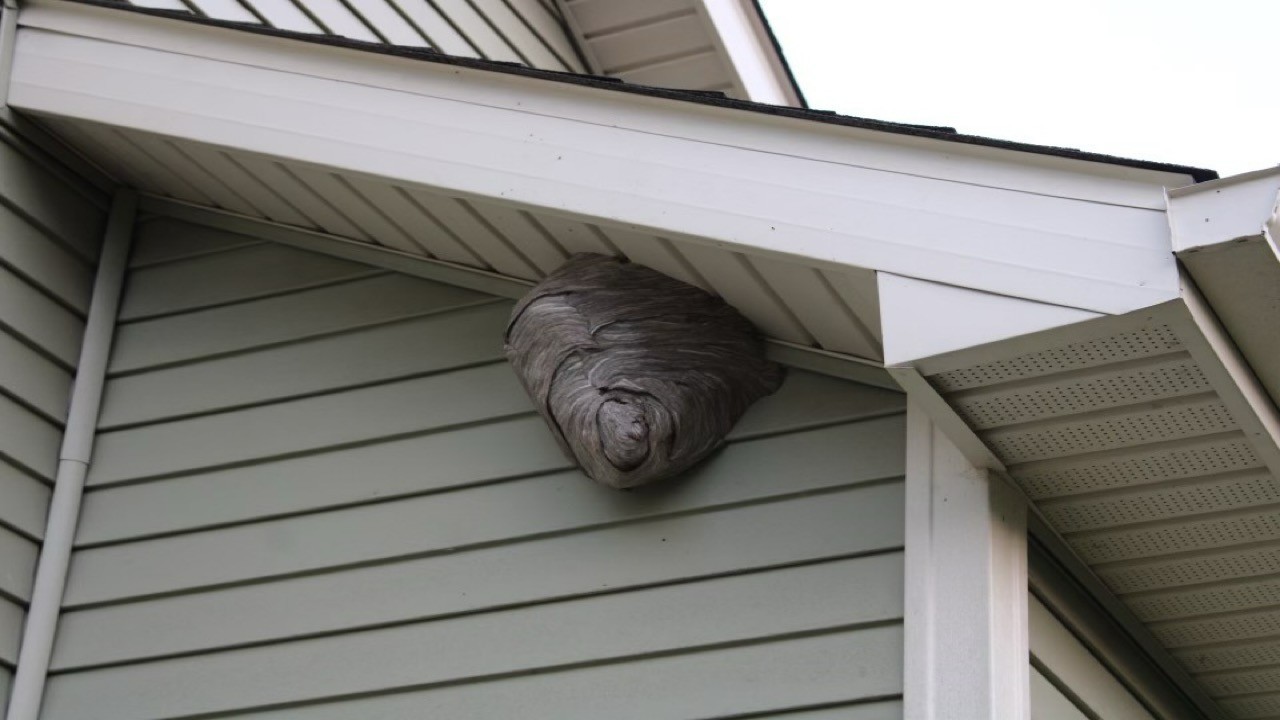
Despite their common name, bald-faced hornets (Dolichovespula maculata) are actually an aerial yellowjacket rather than a true hornet. They build the large gray paper nests commonly seen hanging from trees, shrubs, eaves, and structures.
A mature bald-faced hornet (Dolichovespula maculata) colony can contain a substantial number of workers and may aggressively defend the nest when disturbed.
European Hornets (Vespa crabro)
European hornets (Vespa crabro) are the only true hornet established in the United States. They are noticeably larger than most of the other social wasps homeowners encounter and can reach well over an inch in length. They are typically reddish-brown and yellow with distinctive dark markings on the abdomen.
Unlike the exposed paper nest of a bald-faced hornet (Dolichovespula maculata), European hornets (Vespa crabro) normally establish colonies in concealed cavities such as hollow trees, barns, attics, outbuildings, or wall voids. They are also unusual among our common social wasps because they may remain active after dark and can sometimes be attracted to porch or security lights.
Their size gets people's attention, but European hornets (Vespa crabro) are not automatically a reason to treat. Away from the nest, they are predators of other insects and only become a concern when they are nesting in or immediately adjacent to occupied structures.
Not Everything That Looks Scary Needs to Be Killed
Cicada Killers (Sphecius speciosus)
Cicada killers (Sphecius speciosus) are enormous solitary wasps that often cause alarm because they may hover low over lawns and dig impressive burrows surrounded by excavated soil.
Despite their appearance, they are generally not aggressive toward people. Females can sting, but they are focused on provisioning nests with cicadas rather than defending a colony. Males may patrol nesting areas but cannot sting.
When they show up in a lawn, treatment is not always necessary. They prefer dry, well-drained soil, and simple habitat changes like consistent irrigation or improving turf density can often reduce activity over time.
Mining Bees (Andrenidae)
Small holes and scattered soil mounds in turf are often caused by solitary mining bees (Andrenidae). These bees may nest in large numbers in the same area, but each female maintains her own burrow.
They are important pollinators and are not defensive in the way social wasps are. Because they lack a shared colony to protect, encounters with people are typically minimal.
When they appear in inconvenient areas, habitat modification—such as irrigation or improving turf density—is often enough to discourage nesting.
Our Approach to Wasp, Yellow Jacket & Hornet Problems
1. Identify the Insect
Identification comes first. Paper wasps (Polistes spp.), yellow jackets (Vespula spp.), bald-faced hornets (Dolichovespula maculata), European hornets (Vespa crabro), cicada killers (Sphecius speciosus), and mining bees (Andrenidae) do not behave the same way and should not be treated the same way.
Sometimes identification leads to treatment. Sometimes it leads to reassurance that no action is needed.
2. Locate the Nest or Activity Zone
Some nests are visible. Others require tracking insect movement to a ground opening, wall void, soffit gap, or other concealed entry point.
Understanding location is critical—treating visible foragers alone often does not resolve the actual colony.
3. Apply a Targeted Treatment When Needed
When treatment is necessary, we apply it directly to the nest or activity zone using the most appropriate method for the situation.
We focus on precision and purpose, not blanket applications.
4. Explain What to Expect
Some treatments work quickly, while others require time for returning insects to pass through treated areas.
We explain expected activity, safety precautions, and follow-up expectations so there are no surprises.
What About Honey Bees (Apis mellifera)?
Honey bees (Apis mellifera) are important pollinators and are handled differently from nuisance wasps and hornets. When encountered, they are evaluated for relocation or appropriate management rather than routine treatment.
Can I Remove the Nest Myself?
Small, exposed nests can sometimes be handled early in the season, but many situations are not as simple as they appear.
If there is heavy traffic, a hidden entry point, underground activity, or a nest near an occupied structure, professional evaluation is often the safest option.
Stinging-Insect Control Across Southern Indiana
Greener Pest Management is Veteran-owned and based in Washington County, Indiana, serving Salem, Seymour, Brownstown, Scottsburg, Bedford, Paoli, Corydon, Jeffersonville, and surrounding Southern Indiana communities.
If you have a stinging-insect problem, we’ll identify it, explain it, and recommend the right level of control—nothing more, nothing less.
Get Your Free Quote for Wasp, Hornet, or Yellow Jacket Removal
Worried about dangerous wasps, hornets, or yellow jackets near your home in Campbellsburg, IN? Greener Pest Management offers safe and effective removal. Fill out this quick form, and we'll call you back with a personalized, free quote to eliminate these stinging pests and bring peace of mind back to your property.
Behind the success stories
Read why homeowners and businesses across Southern Indiana—especially in Washington County and Jackson County—call Greener Pest Management the better choice in pest control. This company wasn’t built in a boardroom. It was built in the real world—through grit, long days, and a standard that doesn’t flinch when things get hard. As a Veteran-owned business, we operate by values forged in service: discipline, accountability, and doing the job right even when no one’s watching. That means thorough inspections, targeted treatments, clear communication, and full responsibility for results. If you want pest control that’s honest, consistent, and built to last, you’ll understand our story the moment you read it.

Satisfaction-Focused Service
We don’t promise perfection — we promise follow-through. If a covered pest issue keeps showing up between scheduled visits, you call, and we respond. We’ll come back and re-treat as needed according to your service plan, at no additional charge. No excuses. No disappearing act. Just disciplined work, clear communication, obvious effort, and results we’re willing to stand behind — because that’s how we operate.

Local Knowledge + Seasonal Reality
Built for Southern Indiana Pest Pressure Pest control here isn’t one-size-fits-all. Seasonal swings, old foundations, moisture, and wooded property lines change the game. We know what shows up in Salem, Seymour, Brownstown, and the surrounding counties—and we treat with a plan built for local conditions, not a cookie-cutter script.

13
reviews
109
reviewsGot an emergency?
Wasp, Hornet & Yellow Jacket FAQ for Southern Indiana
Straight answers to the most common questions Southern Indiana homeowners ask about wasps, yellow jackets, hornets, nests, stings, and when professional treatment is actually needed.
The presence of a stinging insect does not automatically mean you have a dangerous situation. What matters most is the species, where the nest is located, and how likely people are to disturb it. Around Southern Indiana, we commonly encounter paper wasps (Polistes spp.), yellow jackets (Vespula spp.), bald-faced hornets (Dolichovespula maculata), and European hornets (Vespa crabro). These are social insects that may defend an established colony when they believe the nest is threatened. A nest high in a tree away from people may never become a meaningful problem. The same colony beside a doorway, deck, children's play area, mower path, or frequently used landscaping bed deserves considerably more attention. Yellow jackets (Vespula spp.) can be especially troublesome because colonies are often underground or concealed inside structural voids. Homeowners sometimes discover them accidentally while mowing, trimming vegetation, or working around the house. For most people, a sting causes temporary pain, redness, and swelling. For someone with a known venom allergy, a sting can become a medical emergency. Multiple stings can also increase the seriousness of an encounter. If you're seeing heavy activity around your Salem, Seymour, Brownstown, Scottsburg, or other Southern Indiana home, give us a call. We can identify what you're dealing with and help determine whether treatment is actually warranted.
There is considerably more biology hiding behind those names than most people realize, and proper identification can completely change how we approach treatment. Paper wasps (Polistes spp.) are the long-legged wasps commonly seen building small, exposed paper-comb nests beneath eaves, decks, porch ceilings, shutters, and other protected areas. Yellow jackets (Vespula spp.) are compact, fast-moving social wasps that commonly nest underground or inside concealed voids. If you see a steady stream of insects disappearing into a hole in the ground, siding gap, soffit, or wall opening, an established colony may be present. Bald-faced hornets (Dolichovespula maculata) build the large gray, enclosed paper nests people commonly see hanging from trees and structures. Despite the name, they are actually an aerial yellowjacket rather than a true hornet. European hornets (Vespa crabro) are true hornets and are substantially larger. They commonly nest inside hollow trees, wall voids, attics, barns, and other cavities. They may also remain active after dark and occasionally show up around exterior lights. That is why our first step is identification. Treating every flying insect as though it were the same pest isn't good pest management.
Usually, no—not until you know exactly what is using it and the colony has been properly addressed. Repeated traffic into the same opening is one of the most useful clues we have when locating a concealed colony. Yellow jackets (Vespula spp.) may disappear into a small hole in the ground, while colonies inside structures may use surprisingly small gaps around siding, soffits, rooflines, utility penetrations, or other openings. Simply plugging that entrance does not necessarily eliminate the colony. If insects are living inside a wall or structural void and their normal exit suddenly disappears, they may begin searching for another way out. The direction they choose is not always toward the outdoors. Instead, leave the entrance alone and watch the traffic from a safe distance. Knowing exactly where they're entering and leaving can make professional treatment considerably more precise. If you have steady stinging-insect traffic entering your Southern Indiana home, call Greener Pest Management before sealing anything. We would rather work with an obvious entrance than go looking for a colony after its doorway has been covered up.
Probably not. One of the most common calls we receive during summer involves cicada killers (Sphecius speciosus). These are enormous solitary wasps that dig burrows in lawns, landscaping, and other areas with dry, exposed soil. Their size and low-flying behavior can make a yard look downright intimidating. Here's the important part: cicada killers (Sphecius speciosus) are not behaving like a colony of yellow jackets (Vespula spp.). Females can sting, but they are primarily interested in hunting cicadas and provisioning their individual burrows. The territorial males that may hover around you cannot sting at all. We see a similar situation with solitary mining bees (Andrenidae). A lawn may suddenly contain dozens or even hundreds of little holes, but these insects are generally important pollinators rather than an aggressive pest colony. If they're somewhere that isn't causing a real problem, our advice is usually simple: leave them alone. If cicada killers (Sphecius speciosus) or mining bees (Andrenidae) choose an inconvenient area, try turning on the sprinkler. They generally prefer dry, well-drained soil, and keeping the area consistently moist can make that location much less attractive. Improving turf density can also reduce suitable nesting sites. Knowing when not to apply pesticide is part of what makes us Greener Pest Management.
Prevention begins well before you have a mature colony hanging over the porch. In spring, overwintered queens begin establishing new colonies. Early nests from paper wasps (Polistes spp.) may contain only a queen and a handful of workers, while later-season colonies can contain substantially more insects. As summer progresses, activity from yellow jackets (Vespula spp.), bald-faced hornets (Dolichovespula maculata), and European hornets (Vespa crabro) becomes much easier to notice simply because colonies have grown. There is no treatment that can guarantee a stinging insect will never build a nest on your property. What we can do is inspect likely nesting areas, remove accessible early-season nests when appropriate, address conducive conditions, and use targeted treatments where they make sense. Around homes in Washington County, Jackson County, Scott County, Lawrence County, Harrison County, Clark County, and Orange County, we pay particular attention to eaves, soffits, shutters, decks, utility penetrations, wall openings, landscaping, outbuildings, and other protected nesting locations. If you start seeing repeated activity or insects traveling to and from the same location, don't wait until you're staring at a fully developed colony. Call Greener Pest Management while the problem is still manageable. We'll identify what you're seeing, tell you whether it actually needs treatment, and recommend the right level of control—nothing more, nothing less.
Other services
Some other service you might be interested in
Roach Control
Your trusted local experts for effective roach removal in southern indiana.
Termite Control
Protect your home from termites in southern Indiana with our expert and reliable control services.